Catchy Introduction – Why Personalization Is the Secret Weapon for Chennai Businesses Every day a Chennai shopper opens a browser, types “best coffee near me” or “affordable web design services in Tamil Tamil Nadu,” and is instantly presented with dozens of options. In a market where the next competitor is just a click away, the difference between …

Catchy Introduction – Why Personalization Is the Secret Weapon for Chennai Businesses
Every day a Chennai shopper opens a browser, types “best coffee near me” or “affordable web design services in Tamil Tamil Nadu,” and is instantly presented with dozens of options. In a market where the next competitor is just a click away, the difference between a visitor who stays and a visitor who leaves often comes down to one simple factor: relevance.
Personalization on business websites is no longer a nice‑to‑have feature; it is a decisive competitive advantage. When a local user sees a homepage that greets them by name, showcases products that match their recent searches, or offers a discount that aligns with their location, the brand instantly feels more trustworthy and valuable.
If you run a boutique in T. Nagar, a B2B service in Guindy, or an e‑commerce store serving the whole of South India, leveraging personalization can transform casual browsers into loyal customers. In this guide, STACK E SYSTEMS walks you through everything you need to know to implement, optimize, and measure personalization on your business website – with a special focus on local SEO, “near me” searches, and the unique expectations of Indian consumers.
Understanding Personalization – The Foundations
What Is Personalization?
Personalization is the practice of delivering website content, offers, and experiences that are tailored to the individual visitor’s characteristics, behavior, and intent. It can be as simple as showing a city‑specific banner (“Free delivery in Chennai”) or as sophisticated as using AI‑driven product recommendations based on a user’s browsing history across multiple devices.
Why Personalization Matters for Local SEO
Search engines increasingly reward sites that demonstrate relevance to a user’s location and intent. When a visitor from Chennai lands on a page that mentions “Chennai” in the headline, displays a local phone number, and offers a city‑specific promotion, Google interprets this as a strong signal that the page satisfies a “near me” query.
Key benefits include:
– Higher click‑through rates from local SERPs
– Lower bounce rates because visitors find exactly what they need
– Increased dwell time, which signals content quality to search engines
– Better conversion rates, leading to stronger signals for commercial intent
Key Personalization Techniques for Business Websites
1. Dynamic Content Blocks
Dynamic content blocks replace static text or images with variations based on visitor data. Examples for a Chennai audience:
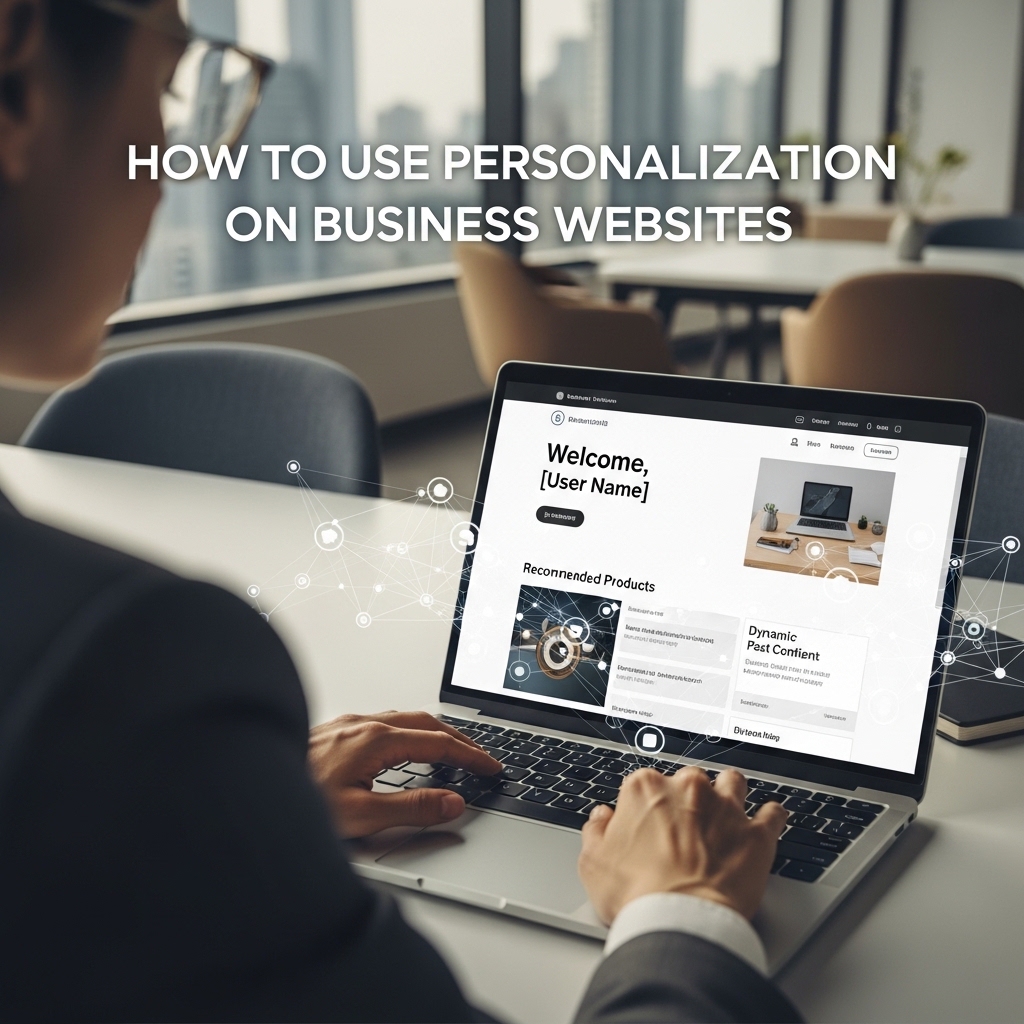
– A hero banner that reads “Welcome, {FirstName} – Explore Our Chennai‑Exclusive Deals”
– A product carousel that showcases items popular in the Koyambedu market
Implementation tip: Use a content management system (CMS) that supports conditional logic, such as WordPress with Elementor Pro, or a headless CMS integrated with a personalization engine.
2. Behavioral Targeting
Behavioral targeting serves content based on a visitor’s actions on your site. Common triggers include:
1. Pages visited (e.g., product category pages)
2. Time spent on a page (e.g., more than 30 seconds)
3. Scroll depth (e.g., reached 75 % of a long‑form article)
A practical example: If a user spends several minutes reading a blog post about “Digital Marketing Services in Chennai,” you can display a pop‑up offering a free SEO audit tailored to Chennai businesses.
3. Geo‑Targeting and “Near Me” Personalization
Geo‑targeting uses IP address or GPS data to identify a visitor’s location. For local businesses, this enables:
– Displaying city‑specific contact information (e.g., “Call us at 044‑12345678 for Chennai customers”)
– Highlighting store hours for the nearest branch
– Offering region‑based shipping discounts
When implementing geo‑targeting, ensure compliance with privacy regulations and provide an easy way for users to opt out.
4. Product Recommendations Powered by AI
Artificial intelligence can analyze a visitor’s browsing patterns, purchase history, and even external data (like trending products in Chennai) to suggest items they are most likely to buy. Benefits include:
– Increased average order value (AOV)
– Higher repeat purchase rate
– Better inventory turnover
Tools such as Dynamic Yield, Algolia, or even custom machine‑learning models can be integrated with your e‑commerce platform.
5. Personalized Calls‑to‑Action (CTAs)
A generic CTA (“Learn More”) often underperforms compared with a personalized one (“Get Your Free Chennai Marketing Consultation”). Strategies:
– Use the visitor’s name or business name in the CTA copy
– Align the CTA with the visitor’s stage in the funnel (e.g., “Download the Chennai SEO Checklist” for top‑of‑funnel users)
– Change button colors or placement based on device type (mobile vs. desktop)
6. Email Integration and Content Upgrades
Personalization does not stop at the website. When a visitor signs up for a newsletter, you can continue the tailored experience through email. For example, a user who downloaded a “Chennai Real‑Estate Market Report” can receive follow‑up emails featuring new listings in their preferred neighbourhood.
Read our guide on Using Content Upgrades to Boost Email Subscribers for detailed tactics on turning website visitors into email leads.
7. Personalized Forms and Lead Capture
Standard contact forms ask for the same fields from every visitor, which can be a friction point. Personalization can:
– Pre‑fill known information (e.g., name, company) for returning users
– Show location‑specific fields (e.g., “Select your nearest Chennai branch”)
– Dynamically adjust the form length based on the visitor’s engagement level
For advanced form optimization, see our article on How to Measure & Improve Contact Form Conversion Rate.
Step‑by‑Step Implementation Guide
Step 1 – Define Your Personalization Goals
Start with clear, measurable objectives. Typical goals include:
– Increase website conversion rate by 15 % within three months
– Boost average session duration for Chennai visitors by 30 seconds
– Grow email subscriber list from local traffic by 20 %
Write each goal in a SMART format (Specific, Measurable, Achievable, Relevant, Time‑bound).
Step 2 – Collect and Segment Visitor Data
Data sources you’ll need:
– First‑party data: website analytics, CRM records, email engagement
– Third‑party data: demographic insights, location databases
– Behavioral data: page views, click paths, scroll depth
Segment visitors into meaningful groups, such as:
– New vs. returning visitors
– Visitors from Chennai, Coimbatore, Madurai, etc.
– Users who have shown interest in a particular product category
Step 3 – Choose the Right Technology Stack
Key components:
– Content Management System (CMS) with personalization capabilities
– Customer Data Platform (CDP) to unify data across channels
– Tag Management System (TMS) for deploying personalization scripts
– Analytics platform for tracking performance (Google Analytics 4, Adobe Analytics)
Popular combinations for Indian businesses:
– WordPress + HubSpot CDP + Google Tag Manager
– Shopify + Klaviyo + Segment
Step 4 – Build and Deploy Personalization Rules
Create a rule library that maps segments to content variations. Example rule set:
| Segment | Trigger | Content Variation | CTA |
|———|———|——————-|—–|
| Visitor from Chennai | IP detected as Tamil Nadu | Banner “Free delivery in Chennai” | “Shop Now” |
| Returning visitor who viewed “Digital Marketing Services” page | Page view recorded | Pop‑up offering free SEO audit | “Claim Audit” |
| New visitor from mobile device | Device type = mobile | Simplified navigation menu | “Explore Services” |
Test each rule in a staging environment before going live.
Step 5 – Conduct A/B and Multivariate Tests
Personalization is an ongoing optimization process. Follow these testing best practices:
1. Test one variable at a time (e.g., headline vs. CTA) to isolate impact.
2. Run tests for at least two weeks to capture weekday vs. weekend behavior.
3. Use statistical significance calculators to determine when results are reliable.
Track metrics such as conversion rate, bounce rate, and revenue per visitor for each variation.
Step 6 – Analyze Results and Iterate
After each test, review the data:
– Did the personalized banner increase click‑throughs from Chennai by at least 10 %?
– Did the AI product recommendations lift average order value?
If a variation underperforms, either refine the rule or replace it with a new hypothesis. Continuous iteration is key to maintaining relevance.
Tools, Platforms, and Services to Accelerate Personalization
Below is a curated list of tools that work well for Indian businesses seeking to personalize their websites:
– Dynamic Yield – Enterprise‑grade personalization engine with AI recommendations.
– Optimizely Web Experimentation – Robust A/B testing and feature flagging.
– Segment (now Twilio CDP) – Centralizes customer data from multiple sources.
– Klaviyo – Email marketing platform that syncs website behavior to email flows.
– Google Optimize (Legacy) – Free A/B testing tool for smaller budgets (note: transitioning to Google Optimize 360).
– Hotjar – Heatmaps and session recordings to understand user interaction.
When selecting a tool, consider integration ease with your existing stack, support for Indian payment gateways, and compliance with local data protection laws.
Case Studies – Real‑World Success Stories from Chennai and Beyond
Case Study 1 – A Boutique Clothing Store in T. Nagar
Challenge: Low conversion rate from mobile visitors, high cart abandonment.
Solution: Implemented geo‑targeted banners offering “Free shipping on orders over ₹2,000 for Chennai customers” and personalized product recommendations based on browsing history.
Result: Mobile conversion rate rose from 2.1 % to 3.8 % within six weeks. Cart abandonment dropped by 12 %, and average order value increased by 9 %.
Case Study 2 – B2B Digital Marketing Agency in Guindy
Challenge: Generating qualified leads from local “digital marketing services near me” searches.
Solution: Deployed a dynamic CTA that displayed a free “Chennai SEO Checklist” download when a visitor spent more than 45 seconds on the services page. Integrated the form with HubSpot CRM and triggered a personalized email sequence.
Result: Lead capture rate improved from 1.8 % to 4.5 %. The agency saw a 30 % increase in booked consultations from Chennai within three months.
For more on creating lead magnets for a Chennai audience, see our article Building a Lead Magnet For Your Chennai Audience.
Case Study 3 – E‑commerce Platform Selling Home Appliances Across Tamil Nadu
Challenge: High bounce rate on product pages for users from smaller cities like Madurai and Trichy.
Solution: Implemented AI‑driven recommendation engine that showcased region‑specific best‑sellers and localized shipping timelines. Added a “View stores near you” widget using Google Maps API.
Result: Bounce rate decreased by 18 %, and revenue per visitor grew by 14 % across all targeted cities.
Best Practices and Common Pitfalls
Best Practices
– Start Small – Begin with one or two high‑impact personalization elements (e.g., location banner, personalized CTA) before scaling.
– Prioritize Privacy – Clearly disclose data collection practices and provide opt‑out options to build trust.
– Maintain Brand Consistency – Personalized content should still reflect your brand voice and visual identity.
– Leverage Local Language – Incorporate Tamil phrases where appropriate to resonate with local audiences.
– Continuously Refresh Content – Stale offers or outdated promotions can erode credibility quickly.
Common Pitfalls to Avoid
– Over‑Segmentation – Creating too many narrow segments can lead to fragmented experiences and maintenance headaches.
– Ignoring Mobile Users – In India, over 70 % of web traffic comes from mobile; personalization must be mobile‑first.
– Neglecting Data Quality – Inaccurate or incomplete data leads to irrelevant personalization, which harms conversion.
– One‑Time Implementation – Personalization is a dynamic process; failing to test and iterate reduces long‑term ROI.
Measuring Success – KPIs and Analytics
Key performance indicators to track:
– Conversion Rate – Percentage of visitors completing a desired action (purchase, form submission).
– Revenue per Visitor (RPV) – Total revenue divided by total visitors; a direct measure of personalization impact.
– Engagement Metrics – Average session duration, pages per session, scroll depth.
– Email Capture Rate – Number of new subscribers generated from personalized content upgrades.
– Form Completion Rate – Success rate of personalized contact forms.
Use Google Analytics 4’s audience builder to create segments for “Chennai visitors” and compare their behavior against the overall audience. Set up custom events for clicks on personalized CTAs to feed data into your CDP for further analysis.
Frequently Asked Questions
Q1: Do I need a large budget to start personalizing my website?
A: Not at all. Many personalization tactics, such as geo‑targeted banners, dynamic CTAs, and simple behavior‑based pop‑ups, can be implemented with free or low‑cost plugins on platforms like WordPress or Shopify. As you scale, you can invest in more advanced AI engines.
Q2: How does personalization affect page load speed?
A: Poorly implemented personalization scripts can add latency. To mitigate this, load personalization logic asynchronously, use a content delivery network (CDN), and keep data payloads lightweight. Test page speed with Google PageSpeed Insights after each deployment.
Q3: Is personalization legal in India?
A: Yes, provided you comply with the Information Technology (Reasonable Security Practices and Procedures and Sensitive Personal Data or Information) Rules, 2011. Obtain explicit consent for cookies, disclose data usage, and give users the ability to opt out.
Q4: Can I personalize for visitors who have never visited my site before?
A: Absolutely. By using IP‑based geo‑targeting and contextual data (e.g., referral source), you can serve location‑specific offers to first‑time visitors. For deeper personalization, you’ll need to capture data through forms or email sign‑ups.
Q5: How often should I update my personalized content?
A: Review performance monthly. Seasonal promotions, new product launches, and changes in local events (e.g., Chennai Music Season) are excellent triggers for updating personalized messages.
Strong Conclusion – Take the Next Step Toward a Personalized Future
Personalization is no longer a futuristic concept; it is a proven driver of higher conversions, stronger local SEO performance, and deeper customer loyalty. By implementing the strategies outlined above—dynamic content, geo‑targeting, AI recommendations, and personalized CTAs—you can turn your business website into a responsive, locally‑relevant experience that resonates with Chennai shoppers and visitors from across Tamil Nadu.
Ready to supercharge your website with data‑driven personalization? STACK E SYSTEMS specializes in building customized personalization frameworks for Indian businesses, from small boutiques to large e‑commerce enterprises. Contact us today on WhatsApp at 9445210058, or explore our resources:
– Learn how to grow your email list with content upgrades.
– Discover the secrets to higher contact form conversions.
– Get a step‑by‑step guide to building a lead magnet for your Chennai audience.
Don’t let generic content hold your business back. Personalize, optimize, and watch your local traffic turn into loyal customers. The future of your website starts now.