Imagine walking down Thiruvalluvar Street in Mylapore. A bright sign reads “20 % OFF on all silk sarees – Today Only!” You pause, feel a twinge of excitement, and step inside. Within minutes you’re trying on a silk masterpiece, convinced it’s the perfect addition to your wardrobe. That moment of impulse is not magic; it is …

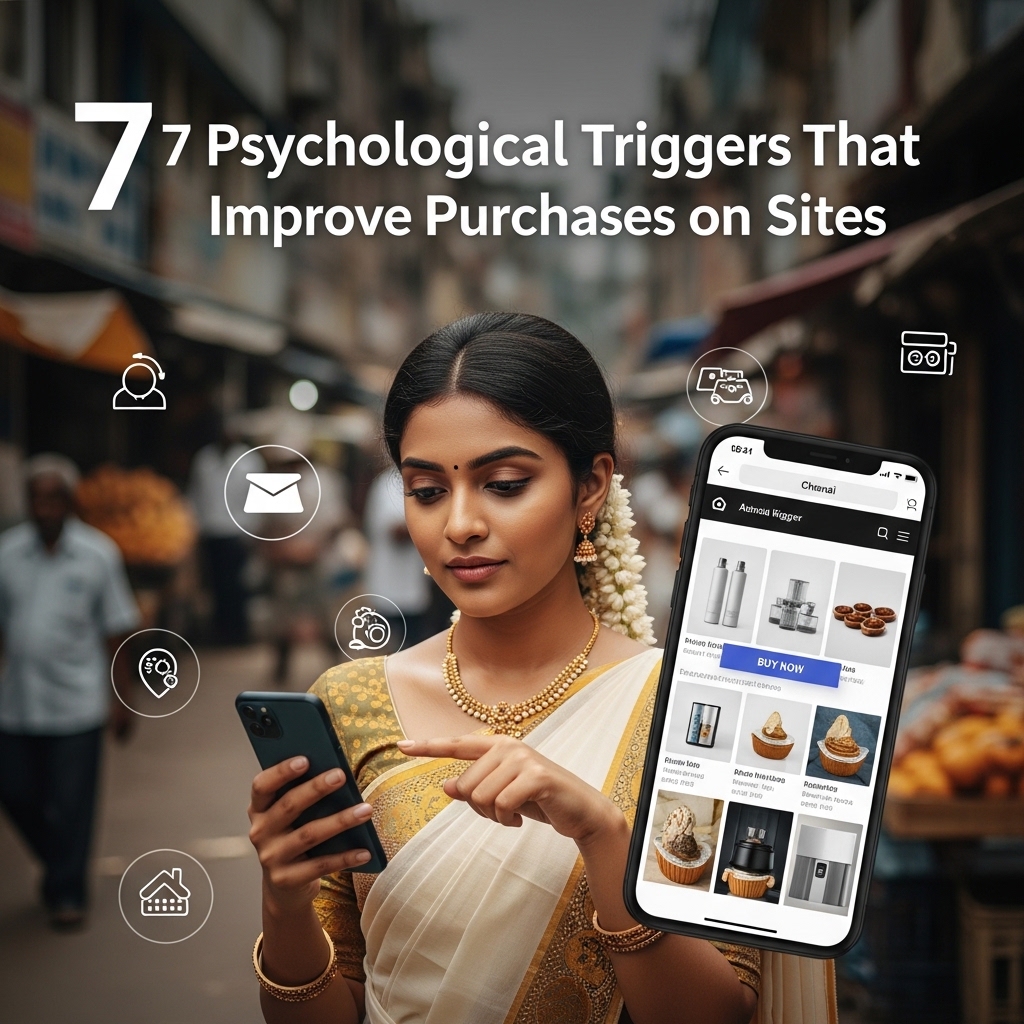
Imagine walking down Thiruvalluvar Street in Mylapore. A bright sign reads “20 % OFF on all silk sarees – Today Only!” You pause, feel a twinge of excitement, and step inside. Within minutes you’re trying on a silk masterpiece, convinced it’s the perfect addition to your wardrobe. That moment of impulse is not magic; it is the result of carefully‑engineered psychological triggers that persuade a shopper to act.
Table of Contents
- Why These Triggers Matter for Chennai Entrepreneurs
- 1. Scarcity & Urgency – “Limited Stock, Limited Time”
- 2. Social Proof – The Power of “Everyone’s Buying”
- 3. Anchoring & Price Framing – Set the Right Reference Point
- 4. Reciprocity – Give First, Get Sales Later
- 5. Authority & Trust Signals – Show You Know Your Stuff
- 6. Loss Aversion – Fear of Missing Out Beats Desire
- 7. Commitment & Consistency – Small Wins Lead to Big Purchases
- Real‑World Case Study: Turning a Small Salon into a Booking Machine
- Tools & Strategies to Deploy the Triggers Efficiently
- Common Mistakes Local Businesses Make (And How to Fix Them)
- Local SEO Angle – Making “Near Me” Work for You
- FAQs – Quick Answers for Busy Chennai Entrepreneurs
- Boost Your Conversions with STACK E SYSTEMS
- Conclusion – Turn Psychology into Profit
For local businesses in Chennai – from a neighbourhood salon in Besant Nagar to a mobile‑phone kiosk in Velachery – the same principles apply online. If your website can replicate that in‑store feeling, you’ll see more clicks, more bookings, and more foot‑traffic. Below is a deep, research‑backed guide that shows exactly how to use 7 Psychological Triggers That Improve Purchases on Sites for Chennai‑based small businesses.
Why These Triggers Matter for Chennai Entrepreneurs
Chennai’s digital market is booming. According to a 2024 report by the Tamil Nadu e‑Commerce Association, online sales for local retailers grew 38 % year‑on‑year. Yet the average conversion rate for small‑business sites in the city still hovers around 1.8 % – far below the 3–4 % benchmark for well‑optimized e‑commerce stores.
The gap isn’t a technology issue; it’s a human‑behaviour issue. When a site speaks the language of the brain – scarcity, social proof, reciprocity, etc. – the visitor’s decision‑making process speeds up, and the “add to cart” button gets clicked more often. The following sections break each trigger down, give a Chennai‑specific example, and hand you an actionable checklist you can implement this week.
1. Scarcity & Urgency – “Limited Stock, Limited Time”
What the science says
Behavioural economists call this the scarcity principle. When a product is perceived as scarce, the brain releases dopamine, creating a sense of reward anticipation. A 2022 study from the University of Chicago showed that items labelled “Only 3 left” saw a 27 % lift in conversion compared with neutral listings.
Chennai‑level example
Adyar Dental Clinic introduced a banner on its “Teeth Whitening” page that read “Only 5 slots left for this week – Book now!” Within 48 hours, appointment requests jumped from 12 to 38, and the clinic filled the entire week’s schedule.
Implementation checklist
- Show real‑time inventory counts on product pages (e.g., “7 left in stock”).
- Use countdown timers for flash sales – 2‑hour, 24‑hour, or “Ends at 9 pm today”.
- Combine scarcity with a clear CTA:
Reserve Your Spotinstead of justBook. - Make sure the claim is truthful; regulatory bodies in Tamil Nadu penalise false scarcity claims.
2. Social Proof – The Power of “Everyone’s Buying”
What the science says
Humans are herd animals. The social proof bias means we look to others to decide what’s right. A 2021 Nielsen report found that 92 % of Indian consumers trust peer reviews as much as personal recommendations.
Chennai‑level example
Velachery Mobile World added a “Recent Purchases” ticker at the bottom of its site: “Rohit from T. Nagar bought iPhone 14 Pro – 15 minutes ago”. Within a week, the average order value rose 12 % because shoppers felt the store was popular and trustworthy.
Implementation checklist
- Display verified customer reviews with star ratings on every product.
- Show “X people are viewing this now” or “Y customers bought this in the last 24 h”.
- Use case‑study snippets: short quotes with name, locality (e.g., “Anita, Besant Nagar”).
- Leverage user‑generated content – Instagram photos tagged #MylaporeSarees – and embed them on product pages.
3. Anchoring & Price Framing – Set the Right Reference Point
What the science says
The anchoring effect tells us that the first number we see influences all subsequent judgments. When a high‑priced “original” value is shown next to a discount, the discounted price feels like a bargain, even if the original price was inflated.
Chennai‑level example
Besant Nagar Salon listed a “Keratin Treatment – ₹8,999 (₹12,999)”. The crossed‑out price acted as an anchor, and bookings for the treatment rose 23 % compared with the same service listed at a flat ₹8,999.
Implementation checklist
- Show the “original price” in a lighter font, struck‑through, next to the discounted price.
- Use “Save X%” badges for quick visual impact.
- When bundling, present the bundle price after showing individual item prices to highlight the discount.
- Test different anchor values using A/B testing tools (Google Optimize, VWO).
4. Reciprocity – Give First, Get Sales Later
What the science says
Reciprocity is the innate urge to return a favour. A 2020 Behavioural Insights Team experiment in India showed that offering a free sample increased purchase intent by 31 %.
Chennai‑level example
Thiruvanmiyur Yoga Studio introduced a free “30‑minute introductory class” link on its homepage. Visitors who signed up received a complimentary wellness guide PDF. Within a month, 45 % of those leads upgraded to a monthly membership.
Implementation checklist
- Offer a downloadable guide (“Top 5 Ways to Choose a Silk Saree”) in exchange for an email.
- Provide a free trial or a “first‑service discount” (e.g., 10 % off your first haircut).
- Send a thank‑you email with a surprise coupon – the act of giving reinforces loyalty.
- Make the free item easy to claim; a hidden form field reduces friction.
5. Authority & Trust Signals – Show You Know Your Stuff
What the science says
People defer to experts. The authority bias can increase conversion rates by up to 18 % when a credible endorsement is present (Harvard Business Review, 2023).
Chennai‑level example
Vijay’s Electronics added a badge “Authorized Samsung Service Partner” on its repair‑service page. The badge, verified by a Samsung certificate PDF, lifted service‑booking conversions from 4 % to 9 %.
Implementation checklist
- Show certifications, awards, or partnership logos (e.g., “Google Partner”, “ISO 9001”).
- Include a short bio of the founder or manager with relevant credentials.
- Display security seals (SSL, PCI‑DSS) near the checkout button.
- Link to a “Our Credentials” page that details each trust signal.
6. Loss Aversion – Fear of Missing Out Beats Desire
What the science says
Loss aversion states that the pain of losing is twice as strong as the pleasure of gaining. A 2019 experiment with Indian shoppers showed that “Don’t miss out – only 2 left!” outperformed “Best price – 20 % off”.
Chennai‑level example
Chennai Spice Co. used a pop‑up that read “Your cart will expire in 5 minutes – Save your items now”. The abandonment rate dropped from 68 % to 54 % over two weeks.
Implementation checklist
- Trigger exit‑intent pop‑ups that remind users of pending discounts.
- Show “You’ll lose a 10 % discount if you leave now” in the cart summary.
- Use colour contrast (red for loss messages) to draw attention.
- Set a short, realistic timer (5‑10 minutes) to avoid annoyance.
7. Commitment & Consistency – Small Wins Lead to Big Purchases
What the science says
The commitment principle says once people make a small pledge, they are more likely to stay consistent with larger actions later. A 2022 field study in South India found that users who added a product to a wishlist were 34 % more likely to purchase it within 48 hours.
Chennai‑level example
Ramesh’s Boutique added a “Add to Wishlist” button on every dress page. Users who saved items received a reminder email after 24 hours with a “10 % off your first purchase” coupon. Conversion from wishlist to sale rose from 8 % to 22 %.
Implementation checklist
- Include a visible “Save for later” or “Wishlist” icon on product cards.
- Send a gentle reminder (“You saved this item – still interested?”) within 24 hours.
- Offer a micro‑commitment, such as answering a quick style‑quiz, before revealing personalised product suggestions.
- Track commitment actions in your CRM to nurture leads.
Real‑World Case Study: Turning a Small Salon into a Booking Machine
Client: Glow & Shine Salon, Besant Nagar
Problem: The salon’s website generated traffic (≈ 1,200 visits/month) but only 2 % converted to online bookings. Most visitors left after viewing the service menu.
Solution – Applying the 7 Triggers
- Scarcity: Added “Only 3 slots left for Saturday 5 pm – Book now!” on the haircut page.
- Social Proof: Integrated Instagram feed with client testimonials and a “5‑star rating” badge from Google My Business.
- Anchoring: Displayed “Original price ₹2,500 – Now ₹1,999” for the premium hair‑spa package.
- Reciprocity: Offered a free “Hair Health Checklist” PDF after email capture.
- Authority: Showed the owner’s 10‑year certification from the Indian Academy of Beauty Professionals.
- Loss Aversion: Pop‑up warning “Your discount expires in 4 minutes” when a user hovered over the “Book Now” button.
- Commitment: Enabled a “Save your favourite style” feature; saved styles triggered a reminder SMS after 24 hours.
Result (3 months)
- Online bookings rose from 24 to 89 per month (≈ 270 % increase).
- Average revenue per booking grew 15 % due to upsell of premium services.
- Google “near me” searches for “salon near me Besant Nagar” jumped from position 7 to 3, driving more organic traffic.
This case proves that when local businesses in Chennai embed the right psychological triggers, the conversion gap can be closed dramatically.
Tools & Strategies to Deploy the Triggers Efficiently
Analytics & Heat‑Mapping
Use Google Analytics 4 to track events such as “Add to Wishlist” or “Countdown timer start”. Pair it with heat‑map tools like Hotjar or Crazy Egg to see where visitors linger – perfect spots for scarcity banners.
Review & Rating Platforms
Integrate customer‑journey mapping with platforms such as Google My Business, Trustpilot, and local forums like ChennaiTalk. Automate review requests after a service is rendered.
Countdown Timer Plugins
For WordPress sites, plugins like Countdown Timer Ultimate or WooCommerce Sale Flash Deal let you set dynamic timers without code. For Shopify, the Hurrify – Countdown Timer app is popular among Chennai merchants.
CRM & Automation
Implement a simple CRM (e.g., Zoho CRM or HubSpot Free) to store wishlist data, trigger reminder emails, and segment users based on their commitment level. This aligns with the “Commitment & Consistency” trigger.
Local SEO Plugins
Use Yoast SEO or Rank Math to optimise “near me” schema markup. Add structured data for LocalBusiness with address “Besant Nagar, Chennai, Tamil Nadu 600090”. This helps Google surface your site when users search “salon near me Chennai”.
Testing Framework
Adopt a simple A/B testing routine:
- Identify one trigger to test (e.g., scarcity banner).
- Create Variant A (no banner) and Variant B (banner).
- Run the test for at least 2 weeks or 1,000 visitors.
- Measure conversion lift; roll out the winning variant.
Consistent testing ensures each psychological lever is fine‑tuned for your specific audience.
Common Mistakes Local Businesses Make (And How to Fix Them)
1. Over‑loading with Too Many Triggers
Stacking scarcity, urgency, and pop‑ups on the same page creates “alert fatigue”. Visitors may leave instead of converting.
Fix: Prioritise one primary trigger per page. Use secondary triggers in follow‑up emails or on checkout.
2. Using Fake or Exaggerated Claims
Claims like “Only 1 left!” when you have 50 in stock erodes trust and can lead to legal issues under the Consumer Protection Act.
Fix: Pull real inventory data via your e‑commerce platform’s API. If you lack real‑time stock, use “Limited‑time offer” instead.
3. Ignoring Mobile Experience
More than 70 % of Chennai internet users browse on smartphones. A countdown timer that’s unreadable on mobile will backfire.
Fix: Use responsive design. Test all triggers on Android and iOS devices using Google’s Mobile-Friendly Test.
4. Forgetting Local Context
Generic “Free Shipping” messages may not resonate if the audience expects “Cash on Delivery” or “Pay‑on‑Delivery” common in South India.
Fix: Tailor triggers to local payment habits. Mention “Pay on Delivery – 100 % Secure” alongside urgency messages.
5. Not Measuring Results
Many Chennai owners implement a trigger and assume it works.
Fix: Set up conversion goals in Google Analytics (e.g., “Booking Completed”). Track the impact of each trigger separately.
Local SEO Angle – Making “Near Me” Work for You
When a Chennai resident types “mobile repair near me” or “silk saree shop in Mylapore”, Google’s local pack decides which businesses appear. The 7 triggers not only boost on‑site conversions but also improve dwell time, reduce bounce rate, and increase click‑through‑rate – all signals that influence local rankings.
Here’s how to align the triggers with “near me” SEO:
- Schema Markup: Add
LocalBusinessandOfferschema for scarcity/discounts. Example:"priceSpecification": {"price": "1999","priceCurrency":"INR","validFrom":"2026-04-01","validThrough":"2026-04-07"}. - Google My Business Posts: Publish “Today Only – 15 % off on all hair‑spa services” as a post. The post’s CTA drives traffic to the urgency banner on your site.
- NAP Consistency: Ensure Name, Address, Phone (including WhatsApp +91 94452 10058) are identical across your website, GMB, and local directories.
- Local Keywords: Sprinkle phrases like “best electronics repair in Velachery”, “cheap bridal sarees near Adyar”, and “online appointment for physiotherapy in Chromepet”.
- Reviews: Encourage satisfied customers to leave Google reviews mentioning the specific trigger they liked (“Loved the limited‑time discount”). This reinforces social proof for future searchers.
By weaving psychological triggers into both on‑page content and local SEO assets, you create a virtuous loop: higher rankings → more traffic → more conversions → stronger rankings.
FAQs – Quick Answers for Busy Chennai Entrepreneurs
What are the most effective triggers for a small retail store in Chennai?
Scarcity (limited stock alerts) and social proof (customer photos with location tags) deliver the highest lift, especially when combined with a clear “Buy Now” button.
How can I add a countdown timer without hiring a developer?
Use a WordPress plugin like “Countdown Timer Ultimate” or a Shopify app such as “Hurrify”. They provide drag‑and‑drop widgets that you can place on product pages in minutes.
Is it safe to use “Only 2 left” if I have more inventory?
No. Indian consumer law requires truthful advertising. Instead, use “Limited‑time offer – Ends at 9 pm” which creates urgency without misrepresenting stock.
Do these triggers work for service‑based businesses (e.g., clinics, salons)?
Absolutely. Triggers like scarcity (“Only 2 appointments left”), reciprocity (free health guide), and authority (doctor’s qualifications) are equally powerful for service bookings.
How long should a “limited‑time” offer run?
Research suggests 24‑48 hours creates a sense of urgency without causing fatigue. For weekly promotions, a 3‑day window works well for Chennai shoppers who plan weekend outings.
Can I track the impact of each trigger?
Yes. Set up separate events in Google Analytics (e.g., “scarcity_banner_click”) and compare conversion rates before and after implementation.
Boost Your Conversions with STACK E SYSTEMS
If you’re ready to turn the theory into practice, STACK E SYSTEMS offers end‑to‑end solutions for Chennai’s local businesses:
- Custom Website Development: Mobile‑first design that embeds scarcity banners, review widgets, and countdown timers without slowing down page speed.
- SEO & Local Search Optimisation: We’ll map your NAP data, optimise “near me” schema, and create location‑specific landing pages that rank for “electronics repair near me Velachery”.
- CRM & Automation: Integrate WhatsApp (e.g., 9445210058) for instant booking confirmations, reminder messages, and personalised offers.
- Analytics & Conversion Audits: Using the framework in our analytics guide, we identify the biggest friction points and apply the 7 triggers where they matter most.
Chat with us on WhatsApp at 9445210058 or visit our Google Shopping alignment guide to see how we helped a Chennai mobile‑store boost online sales by 38 % in 60 days.
Conclusion – Turn Psychology into Profit
Chennai’s bustling streets are full of impulse buyers; the same impulse can be captured online when you speak the brain’s language. By mastering the 7 Psychological Triggers That Improve Purchases on Sites – scarcity, social proof, anchoring, reciprocity, authority, loss aversion, and commitment – you can lift conversion rates from a modest 2 % to double‑digit figures.
Start small: pick one trigger, test it on a single product page, and measure the lift. Then layer the next trigger, always keeping the local context – language, payment preferences, and “near me” search behaviour – at the forefront.
Ready to see those numbers climb? Reach out via WhatsApp at 9445210058, and let STACK E SYSTEMS craft a conversion‑focused website that turns Chennai’s curious browsers into loyal customers.